Newsletter July 2026: Decree 186/2026 Redraws the Map of Industrial Property Enforcement
ISSUE 1 – JULY 2026
1. A Reform Born of Two Pressures
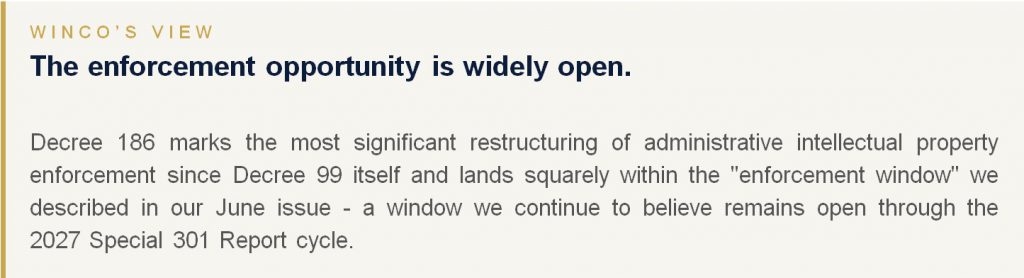
It would be quite natural to read Decree No. 186/2026/ND-CP of 26 May 2026 (“Decree 186”), in force since 15 July, as the next instalment of the story this newsletter covered in the June issue: the Special 301 designation of 30 April, Official Telegram No. 38/CĐ-TTg of 5 May, the peak campaign of 7-30 May, and now, three weeks later, a structural amendment to the sanctioning regime for industrial property.
It is also worth noting that the recitals of Decree 186 invoke, among others, the 2025 Law on Organisation of the Government, the 2025 Law on Organisation of Local Government, and the new Law on Inspection No. 84/2025/QH15 – the statutes through which Vietnam has, over the past year, dismantled its ministerial inspectorates, merged its provinces, abolished the district tier, and restructured customs and market surveillance. The Inspectorate of the Ministry of Science and Technology, on which the enforcement architecture of Decree No. 99/2013/ND-CP (“Decree 99”) had rested since 2013, ceased to exist in its former shape. Some organ had to inherit the file. Decree 186 answers that question – and, in answering it, takes the opportunity to arm the regime with remedies Decree 99 never contained.
Viewed in this context, Decree 186 is more than a technical amendment or a response to immediate enforcement concerns. Rather, it represents the point at which Vietnam’s domestic administrative reforms and the heightened international focus on intellectual property enforcement converge in a single legislative instrument.
2. Who Now Holds The Pen
The restated Article 15 of Decree 99 distributes sanctioning competence afresh. At its apex stands the Director General of the Intellectual Property Office of Vietnam (“IP Vietnam”), competent – together with the heads of specialised industrial property inspection teams established by the Director General or by the Minister of Science and Technology – over the entire catalogue of violations in Chapter II of Decree 99. The former inspectorate provisions (Articles 16 and 17) are repealed without replacement. Around this new centre, the familiar bodies retain defined lanes: Market Surveillance for goods in domestic circulation (with an express power, newly articulated, to follow a violation upstream to the production facility once identified); Customs for import, transit, and carriage within the customs territory; the police for a specified list including counterfeit-mark goods and violations concerning stamps, labels, and packaging; and the People’s Committees for violations arising within their localities.
Two entrants deserve particular notice: Directors of provincial Departments of Science and Technology, who receive sanctioning competence for the first time, and the Department of Cyber Security and High-Technology Crime Prevention, whose directors and division heads are now named in their own right – the clearest signal in the text that online infringement is expected to supply a growing share of the caseload.
Table 1 – Fining Authority (Selected)
| Authority (Selected) | Fine Ceiling* |
| Director General, IP Vietnam | VND 250M |
| Head, IP inspection team established by the Minister of Science & Technology | VND 250M |
| Head, IP inspection team established by the Director General of IP Vietnam | VND 200M |
| Director, provincial Department of Science & Technology | VND 200M |
| Chairperson, provincial People’s Committee | VND 250M |
| Chairperson, commune-level People’s Committee | VND 125M |
* Ceilings for individuals under Articles 15a and 18–21 of Decree 99 as restated by Decree 186; doubled for organisations.
The table is illustrative, not exhaustive as lower-ranking positions hold correspondingly lower ceilings
Two features of this change deserve particular attention.
The first is consolidation. The authority responsible for examining and granting industrial property rights is now also empowered to sanction their infringement. For rights holders, this promises relief from the chronic bottleneck discussed in our June newsletter—cases stalled at the expert assessment stage because enforcement authorities lacked the technical confidence to reach their own conclusions. The authority that granted the right no longer needs to seek an external opinion on its scope.
The second feature is the corollary of the first, and it is less reassuring. Concentrating the functions of examination, grant, interpretation, and enforcement within a single institution removes the functional separation that the previous system, albeit inadvertently, provided. A respondent challenging IP Vietnam’s interpretation of a right granted by IP Vietnam will now, in substance, be asking the same institution to reconsider its own position. Over time, this is likely to increase the practical significance of judicial review as the principal external safeguard. Rights holders will welcome the greater efficiency; defence counsel will note the resulting asymmetry. Both perspectives are well founded.
The restated Article 30 adds a procedural keel: each violation is to be sanctioned once only; where several persons commit one violation, each is sanctioned; where one person commits several, each violation is sanctioned separately. The same Article opens the door – conditioned on infrastructure – to the handling of industrial property violations wholly in the electronic environment, under Article 18a of the Law on Handling of Administrative Violations.
3. From Punishing the Seller to Reaching the Infrastructure
The deeper innovation of Decree 186, in our reading, is not who sanctions but what may be ordered – and against whom. The classical model of Decree 99 acted on the infringer: fines, confiscation, and suspension of business. Its weakness, as we observed in June, was the infringer who cannot usefully be acted upon – anonymous, judgment-proof, or simply willing to fold one storefront and open the next. Decree 186’s response is to write the gatekeepers into the remedial provisions, each with hard deadlines of its own.
For domain names, the remedies now form a graduated ladder. During proceedings, the registration and use of a disputed domain may be frozen in place. On a finding of violation, the domain may be ordered returned (the violator must complete the procedure within 30 days) or, failing that, revoked by coercive enforcement – with the Vietnam Internet Centre, the “.vn” registrar, international-domain registrars operating in Vietnam, and, in a sign of careful drafting, the registries of new gTLDs all assigned execution roles. And at the top of the ladder sits the wholly new measure: blocking of access to the infringing domain, ordered by the sanctioning authority and executed by telecommunications enterprises under the new Article 31(3a) – blocking within five days of the decision, restoration within three days if the decision is reversed, and a written report within ten days of each. The blocking remedy attaches across the Chapter II catalogue and expressly to domain-related unfair competition under the amended Article 14(18)(c).

The procedure is tightly regulated from start to finish: the violator has 60 days from the effective date of the decision to make the change, and a further ten days to report it; if this is not done, the sanctioning authority notifies the business registration authority, which must within five days require the violator to report and explain, and thereafter proceed in accordance with the Law on Enterprises.
4. What Remains Unwritten
That said, Decree 186 has yet to fully resolve three key issues.
First, the Decree contains no transitional provision for enforcement requests still pending before the former inspectorate channel as of 15 July 2026; rights holders with existing cases should not assume anything, but should instead verify which authority now has jurisdiction over their matter.
Second, the Decree prescribes the access-blocking measure but not the corresponding evidentiary threshold – how much evidence, and of what kind, is needed for the competent authority to issue a blocking decision within five days – a question the first cases will have to settle.
And finally, there is as yet no assurance of institutional capacity: IP Vietnam takes on sanctioning authority at the very moment the shortened examination timelines under the amended Law on Intellectual Property (in force since 1 April 2026) are placing growing pressure on that same office. Whether the new center can carry both functions without either one suffering – that is the question on which this reform will ultimately be judged.