The End of the Anonymous Seller: Vietnam’s New E-Commerce Law, Decree 248/2026, and Platform Liability for IP Infringement
ISSUE 1 – AUGUST 2026
1. Background: From Decree 52 to a Statutory Framework
Since 2013, e-commerce in Vietnam has been governed not by statute but by subordinate legislation – Decree No. 52/2013/ND-CP, as amended by Decree No. 85/2021/ND-CP. That framework, drafted for an earlier generation of online commerce, provided only limited coverage of the business models that now dominate the sector – livestream selling, affiliate marketing, social commerce – and sat uneasily alongside the laws on consumer protection, taxation, and intellectual property, producing the enforcement inconsistencies with which rights holders are well acquainted.
On 10 December 2025 – the same day, it may be noted, on which the National Assembly adopted the amendments to the Law on Intellectual Property – the Assembly passed the Law on E-Commerce (the “E-Commerce Law”), comprising 41 articles in seven chapters. The Law entered into force on 1 July 2026, replacing the Decree 52 framework. It was accompanied, with conspicuous punctuality, by Government Decree No. 248/2026/ND-CP of 30 June 2026 (“Decree 248”), detailing a number of its articles and taking effect on the same date; the Ministry of Industry and Trade’s Vietnam E-commerce and Digital Economy Agency convened its dissemination conference on the two instruments on 3 July 2026.
Two features of the new statute define its character. First, it has extraterritorial reach: it applies to both domestic and foreign organisations and individuals engaged in e-commerce activities in Vietnam, and imposes specific management, operation, and registration conditions upon foreign e-commerce platforms serving the Vietnamese market (Article 27). Second, it is stratified: platforms are classified into distinct categories – extending to newly arising models such as specialised digital-service platforms – with differentiated liability regimes attaching to each, in place of the largely undifferentiated treatment of the former regime.
The legislative context, once again, is the enforcement tightening chronicled in our June issue. The Prime Minister issued a directive in January 2026 specifically addressed to IP enforcement and consumer protection in e-commerce; the e-commerce platforms were an express focus of Official Telegram No. 38 and the May peak campaign; and the Ministry of Industry and Trade reported at the National Steering Committee 389 conference of 7 July 2026 that, in the first half of 2026 alone, it had worked with e-commerce platforms to remove more than 9,000 infringing products. The E-Commerce Law supplies the statutory backbone that those campaign-based efforts previously lacked.
2. The Provisions of Principal Relevance to Rights Holders
2.1 The prohibition on counterfeit and infringing goods – extended to facilitation
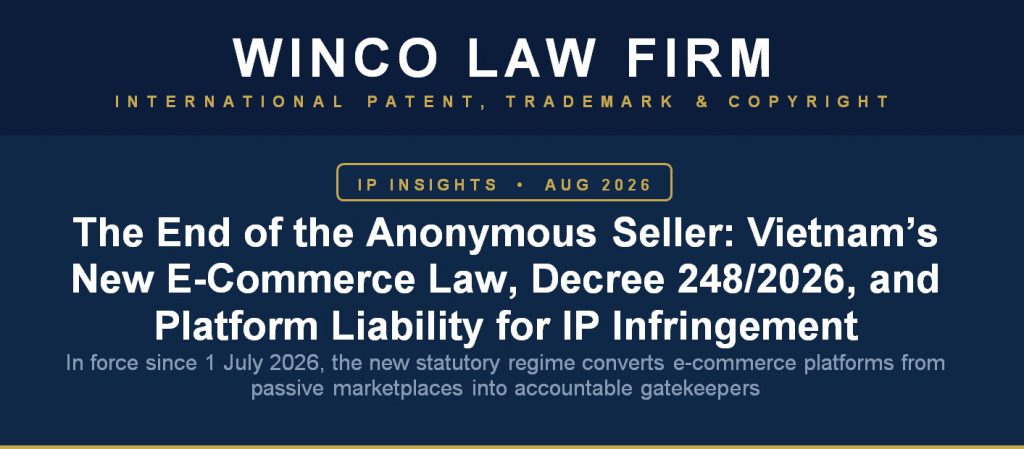
Article 6 of the E-Commerce Law strictly prohibits conducting business in – or facilitating others to conduct business in – counterfeit goods, goods infringing intellectual property rights, smuggled goods, goods of unclear origin, expired goods, and related categories, on e-commerce platforms. The express extension of the prohibition to facilitation is the pivotal drafting choice: it is the textual foundation upon which platform responsibility for third-party infringement is constructed.
2.2 Mandatory seller identity verification
Under Decree 248, operators of intermediary e-commerce platforms are required to verify sellers’ identities before permitting them to trade on the platform – a measure expected, in the Ministry of Industry and Trade’s own assessment, to substantially reduce anonymous and unverified accounts. Verification is anchored to the national electronic identification framework (VNeID), and large platforms are additionally subject to user-account verification obligations under Decree No. 147/2024/ND-CP.
The significance of this measure for IP enforcement can scarcely be overstated. In our June issue we identified, as the third structural bottleneck in Vietnamese enforcement, the ease with which anonymous accounts are established and re-established – offenders absorbing administrative penalties, closing one page, and opening another. Mandatory identity verification attacks that pathology at its source: the infringing seller becomes an identified, and therefore reachable, legal subject, against whom administrative, civil, and criminal process may be directed, and whose recidivism across successive storefronts becomes traceable.
2.3 Monitoring, removal, retention, and reporting obligations
Platform operators bear ongoing accountability obligations, including the active monitoring and removal of unlawful trading activities; cooperation with, and compliance with takedown requests from, State authorities; periodic reporting through the national E-Commerce Management System (online.gov.vn); algorithmic transparency; product-defect disclosure and recall duties; and the retention of product and service information for at least one year and contract information for three years (with a lighter one-year retention standard available to innovative start-ups, micro-enterprises, and business households in their early years). The retention obligations merit particular attention from rights holders: they create, for the first time, a statutorily mandated evidentiary trail within the platform – directly responsive to the electronic-evidence bottleneck discussed in our June issue, in which infringement records were readily erased before enforcement authorities could act.
2.4 Joint liability of platforms
Most significantly, the E-Commerce Law introduces a joint liability regime: a platform operator that fails to fulfil its legal obligations, and thereby causes harm to consumers, may be held jointly liable with the seller for the resulting damages – a regime whose reach encompasses product quality, prohibited goods, and counterfeit products. The commercial logic is deliberate: liability is directed toward the deeper-pocketed and readily traceable platform, thereby conscripting the platform’s own compliance apparatus into the policing of its sellers.
2.5 Sanctions, blocking, deposits, and the blacklist
Non-compliance attracts consequences extending well beyond administrative fines: authorities may order the blocking of access to specific platform functions or the suspension of e-commerce activities altogether, and conduct bearing indicia of criminal offences is referred for disposition under the Penal Code. The national E-Commerce Management System will publish both a public register of compliant platforms and a blacklist of violating entities – a reputational sanction whose commercial force, in a market as concentrated as Vietnamese e-commerce, may prove no less potent than the pecuniary ones. Foreign platforms exempted from establishing a local entity under international agreements must nonetheless place security deposits at commercial banks to secure compensation for consumer damages and financial obligations to the State, in amounts to be clarified by implementing regulation.
3. Convergence: The E-Commerce Law, the Amended IP Law, and Decree 186
The E-Commerce Law does not operate in isolation; it is one panel of a triptych completed within a single quarter.
The amended IP Law (in force 1 April 2026) broadened the definition of intermediary service providers under Article 198b to encompass digital platforms generally, and – through the new Article 198b.5a – imposed upon platform operators an affirmative obligation to implement technical and organisational measures protecting IP rights in cyberspace, in accordance with the laws on intellectual property, e-commerce, and cybersecurity. This marks a shift from the purely reactive takedown model to proactive compliance duties, and the courts are now expressly empowered to order takedowns or the blocking of online content and accounts at both the preliminary and final stages of proceedings.
Decree 186/2026 (in force 15 July 2026, and the subject of our companion article in this issue) supplies the administrative counterpart: compulsory blocking of infringing domain names as a remedial measure in industrial property cases, executed by telecommunications enterprises within five days of a blocking decision, together with the express empowerment of the Cyber Security and High-Technology Crime Prevention force.
The E-Commerce Law and Decree 248 complete the structure by regulating the marketplace layer itself: identified sellers, monitored listings, retained records, and platforms exposed to joint liability.
The combined effect is that, as of this month, every layer of the online infringement chain – the seller, the listing, the platform, the domain, and the network operator – is subject to an enforceable legal obligation or remedy. That statement could not have been made at any prior point in the history of Vietnamese IP law.
4. Open Questions
Candour requires acknowledgment of what remains unsettled. The sanctioning decrees particularising penalties under the E-Commerce Law are still anticipated, and until they issue, the practical severity of the regime cannot be fully assessed. The joint liability mechanism is untested before the courts, and its interaction with the fault-based principles of the Civil Code will require judicial elaboration. Enforcement against offshore platforms – particularly those declining to register or to post the required deposits – will test the extraterritorial reach of the statute in practice. And the compliance burden upon platforms is substantial; a period of uneven implementation, particularly among smaller and cross-border operators, should be expected.