Vietnam Tightens IP Enforcement Amid U.S 301 Report
ISSUE 1 – JUNE 2026
1. Background: The Special 301 Report and Vietnam’s Elevation to “Priority Foreign Country” (PFC) Status
The Special 301 Report constitutes the annual review mechanism conducted by the Office of the United States Trade Representative (USTR) pursuant to Section 182 of the Trade Act of 1974 (19 U.S.C. § 2242), for the purpose of assessing the adequacy and effectiveness of intellectual property protection and enforcement by U.S. trading partners. The Report classifies foreign jurisdictions into three escalating tiers of risk: the Watch List, the Priority Watch List, and the Priority Foreign Country (PFC) designation. The PFC designation represents the highest tier, signifying that the United States may initiate an investigation under Section 301 of the Trade Act – a procedural predicate for the imposition of unilateral trade sanctions.
For many years, Vietnam was placed solely on the Watch List. The 2025 Report, published on 29 April 2025, maintained Vietnam in that tier, alongside Thailand and sixteen other jurisdictions. On 30 April 2026, however, the USTR took an unexpected step: it elevated Vietnam directly from the Watch List to the PFC tier, bypassing the Priority Watch List entirely, and singling out Vietnam as the sole jurisdiction at the highest level of concern. This marks the first instance in thirteen years in which any country has been so designated.
The USTR set forth five grounds for its determination: online copyright piracy; counterfeit goods; insufficiently effective border enforcement; the use of unlicensed software; and the absence of criminal sanctions in respect of the unauthorised interception of cable and satellite signals. Under United States law, the USTR is afforded thirty days within which to determine whether to commence a Section 301 investigation. Should such an investigation be initiated, the USTR will formally request consultations with Vietnam – a mechanism which, if it reaches an impasse, may culminate in the imposition of punitive tariffs.
It bears emphasis that the elevation occurred notwithstanding the 2025 Report’s acknowledgement of certain enforcement advances on the part of Vietnam, including measures taken against the pirate streaming sites Xoilac, Fmovies, and Rophim. The decision to bypass the Priority Watch List and proceed directly to PFC designation suggests that the USTR regarded the responses up to that point as commensurately inadequate relative to Vietnam’s commitments, and intended to deploy its most coercive available instrument.
2. Official Telegram No. 38 – A Policy Response at the Highest Level of Government
The foregoing context explains the urgency of Official Telegram No. 38/CĐ-TTg, issued by the Prime Minister in early May 2026, mere days after the USTR’s publication of the Special 301 Report. The Telegram is no ordinary technical instrument; it constitutes an administrative directive compelling the entire State apparatus to mobilise simultaneously and with unprecedented intensity. On 6 May 2026, the Ministry of Science and Technology promulgated Decision No. 2309, accompanied by a concrete action plan.
The preliminary results reflect that urgency. By 27 May 2026, three weeks after mobilisation, 1,438 cases of intellectual property infringement had been detected and processed, of which 1,146 were resolved by administrative sanction and 28 were referred for criminal prosecution; the aggregate amount of fines imposed reached approximately VND 12.6 billion. The number of criminal prosecutions instituted within three weeks was equivalent to approximately 60% of the total number of prosecutions instituted throughout the whole of 2025; the Market Surveillance Authority alone recorded an approximately 210% increase in cases handled relative to May 2025, exceeding its assigned targets by approximately 158%.
By the one-month preliminary review conference (2 June 2026), the figures had become still more pronounced: 2,036 cases bearing indicia of infringement had been detected; 1,616 cases had been disposed of by administrative sanction, with aggregate fines exceeding VND 17.8 billion and the value of infringing goods exceeding VND 115.5 billion; 44 cases had been referred for criminal prosecution, with 4 cases involving 4 accused persons brought to trial. In the digital domain, access to 1,073 infringing websites and 612 unauthorised television broadcasting sites had been blocked.

As to the composition of the cases handled, the overwhelming majority of administrative matters – 1,587 out of 1,616 – concerned infringement of rights in trademarks and geographical indications; only 27 concerned copyright and related rights. This distribution accurately reflects the prevailing character of infringement in Vietnam (counterfeit and imitation goods), and corresponds with the concerns articulated by the United States regarding counterfeiting.
In parallel, Official Telegram No. 38 has accelerated legislative reform. The Ministry of Public Security is presently coordinating with the Ministry of Justice and other ministries and sectoral authorities in studying amendments to the Penal Code, with a view to strengthening the sanctions provided under Articles 225 and 226, and concurrently introducing provisions to criminalise the unauthorised interception of cable and satellite signals – precisely the fifth ground cited in the USTR’s determination. This constitutes a direct and deliberate legal response.
3. Constructive Developments and the Path Forward
Looking ahead, three positive developments warrant recognition, and three structural bottlenecks remain to be resolved if Vietnam is to move beyond a contingent response to the Special 301 Report and construct a sustainable enforcement regime.
The first constructive development is the velocity of the policy response. The interval between the USTR’s publication of the Report and the issuance of Official Telegram No. 38 was less than one week. From the standpoint of administrative law, this is a clear manifestation of a centralised command mechanism activated where external pressure is perceived as a matter of economic security. The establishment of a nationwide daily expedited reporting mechanism likewise generates real-time data to inform executive decision-making – a capability that previously was virtually non-existent.
Second, inter-agency coordination has undergone substantive transformation, no longer confined to paper commitments. The Ministry of Culture, Sports and Tourism is coordinating with the Ministry of Public Security in the exchange of information and the referral of files to prosecutorial authorities in cases bearing indicia of criminal conduct; the Economic Police Force has conducted training for functional forces across 34 provinces and municipalities. The National Database on Intellectual Property Enforcement is anticipated to be completed within 2026, integrating administrative and criminal enforcement data, paradigmatic cases, and expert assessment data on a nationwide basis – and, if effectively operationalised, will constitute the foundational infrastructure for long-term enforcement.
Third, the amended Law on Intellectual Property, which entered into force in April 2026, has established a renewed legal foundation, while the ongoing process of amending the Penal Code is proceeding in the correct direction to close the lacuna concerning cable and satellite signals.
Three bottlenecks, however, remain conspicuous. First, the matter of expert assessment and the establishment of legal grounds – as Deputy Minister Ho An Phong has observed, the detection of infringing conduct is not unduly difficult, but conducting expert assessments and establishing the legal grounds necessary to support enforcement action present serious difficulties. This is a vulnerability the USTR may continue to exploit if cases are suspended at the assessment stage and fail to produce dispositive determinations.
The second bottleneck involves electronic evidence. Electronic evidence is readily erased or altered; many enforcement authorities have not yet been fully digitalised so as to extract and preserve such evidence in a legally admissible manner. The Ministry of Industry and Trade has accordingly proposed the establishment of a mechanism permitting criminal prosecution to be initiated on the basis of electronic evidentiary indicators – such as engagement metrics and digital revenue figures displayed on online systems – rather than relying exclusively upon the physical enumeration of seized articles in warehouse premises. This requirement is unavoidable as infringement progressively migrates into the digital environment.
Third, administrative sanctions presently lack adequate deterrent effect against recidivist conduct on anonymous platforms. The ease with which anonymous accounts may be established on online platforms and social media networks has produced a situation in which many offenders are content to absorb administrative penalties and simply close one page in order to establish another, thereby undermining the efficacy of territorial enforcement.
As a matter of strategy, the cardinal issue is that Vietnam must clearly distinguish between a “peak campaign” and “routine enforcement.” A short-term mobilisation may serve to reduce the pressure arising from the Special 301 Report for a period of several months and to constitute a signal of good faith in the forthcoming Section 301 consultations. If, however, this mobilisation is not converted into a mechanism of continuous enforcement – through the establishment of a corps of specialist examiners, an interoperable database, digital investigative capacity, and the timely amendment of the Penal Code – Vietnam may continue to be retained at PFC status in the 2027 review cycle, with commercial consequences materially graver than those presently confronted.
4. The Tightening Trend and WINCO’s View
Synthesising the developments set forth above, it may be affirmed that the enforcement of intellectual property rights in Vietnam has entered a phase of pronounced tightening – not merely a contingent mobilisation, but a systemic shift driven by the conjoined pressures of international commitment (Section 301) and domestic political determination. The indicators are convergent and synchronous: the amended Law on Intellectual Property in force from April 2026; Official Telegram No. 38 issued at the Prime Ministerial level; the trajectory of amendments to Articles 225 and 226 of the Penal Code now being advanced; the National Enforcement Database scheduled to be operational by the end of 2026; and the daily expedited reporting mechanism among ministries and sectoral authorities established for the first time.
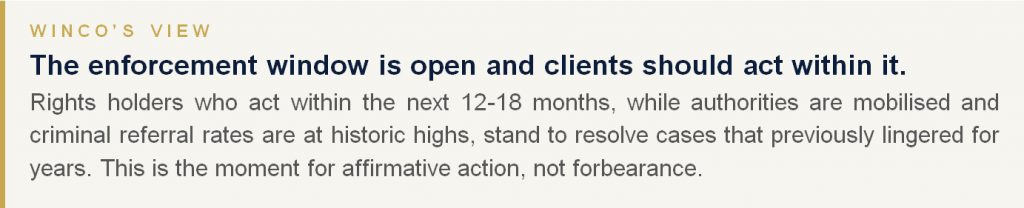
For rights holders – both domestic and foreign – this constitutes auspicious intelligence. Over the past two decades, the principal obstacle to the enforcement of intellectual property rights in Vietnam has resided not in the inadequacy of the law, but in the divergence between the law as written and the capacity for its enforcement in practice. That divergence is now being materially narrowed: the number of criminal prosecutions instituted in a single month has exceeded the total instituted throughout all of 2025; the Market Surveillance Authority has mobilised with productivity gains in excess of one hundred per cent; and the inter-agency coordination mechanism – long an entrenched weakness – has been brought into genuine operation. More importantly, the pressure arising from Section 301 will continue to sustain elevated “temperature” at least until the 2027 Special 301 Report cycle, meaning that the optimal window of action for rights holders falls within the next 12 to 18 months.
On that basis, we are of the view that this is the strategic moment for enterprises holding intellectual property assets in Vietnam to take affirmative action, rather than to maintain the posture of forbearance that characterised the preceding period. Specifically, rights holders should undertake a comprehensive review of their portfolios of registered trademarks, patents, and industrial designs – with particular attention to subject matter showing indicia of infringement that has not been conclusively resolved – and accelerate pending expert assessments and outstanding requests for enforcement action. By leveraging the present interval, during which enforcement authorities are actively mobilised, response times have been shortened, and the rate of referral for criminal proceedings has reached unprecedented levels, it will be possible to resolve within a matter of months cases that previously could have remained unresolved for many years.
Concurrently, mechanisms for monitoring the digital environment must be put in place – most notably with respect to e-commerce platforms, social media, and content distribution services – as these now constitute the new locus of enforcement, and the area in which Vietnam is proactively requiring cross-border platforms to remove infringing content. For foreign rights holders, the prompt designation of an authorised representative in Vietnam capable of expeditiously responding to requests for confirmation from the competent authorities is a virtually indispensable condition; delay in response by foreign rights holders is presently among the most significant bottlenecks expressly identified by the Ministry of Industry and Trade itself, and the reason that many cases remain suspended at the administrative stage.
In short, external pressure has opened a policy window which, for a considerable period, has not been so wide. Rights holders who act early within that window will reap the greatest benefit; conversely, those who await the abatement of the peak campaign will find that the cost and time of enforcement revert to their pre-Telegram No. 38 levels. In this context, the role of the industrial property representative organisation in Vietnam is no longer confined to the procedures for the establishment of rights, but extends to strategic enforcement counsel – guiding rights holders in the selection of the appropriate channel (administrative, criminal, civil, or platform takedown), at the appropriate time, and in coordination with authority, to maximize effectiveness.