ARTICLE 1: GLOBAL INTELLECTUAL PROPERTY TRENDS IN 2025
(Part 1: Intellectual Property accompanies Artificial Intelligence)
Intellectual Property (IP) is no longer a “passive shield” (registering and leaving it be) but has become an “active weapon” (used for competition and valuation).
Below is a detailed analysis of each aspect and specific actions that businesses/individuals have used to adapt to this trend in 2025:
- Artificial Intelligence (AI): The Boundary between Human and Machine
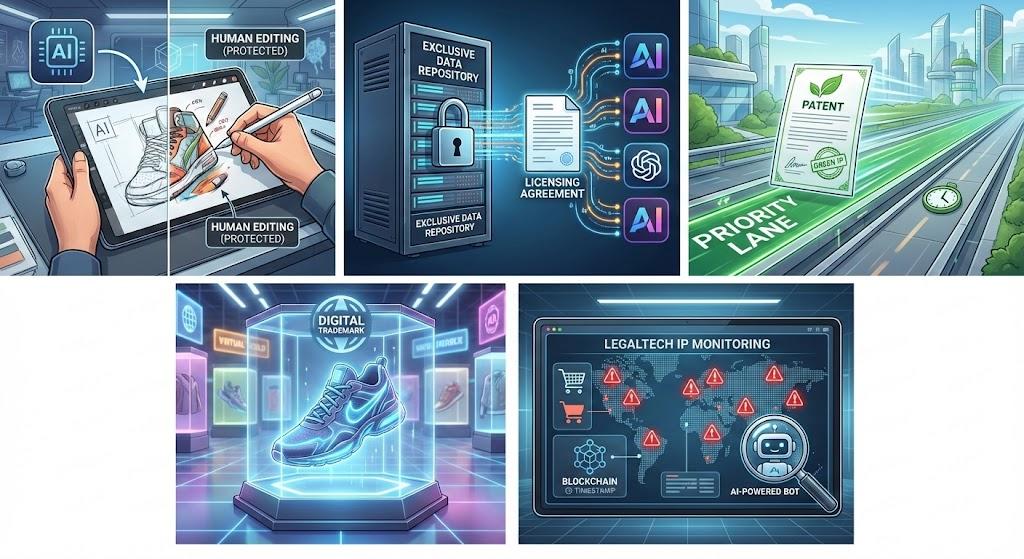
This is the “greyest” and most complex area. The 2025 trend does not ban AI but demands absolute transparency regarding the human role.
- Core Issue: Granting authorities (such as in the US, Europe, and soon Vietnam) are applying the principle: “AI is a tool, not an author.”
- Your Strategy:
- Audit Trail: If you use AI to write code, draw, or write text, you must save your own editing steps.
- The “Sandwich” Rule: Human Idea / AI creates the draft / Human edits and finalizes. Only the “Human Edited” part has a high probability of protection.
- Real-world Example: If you use Midjourney to create a logo, you do not own the copyright to that logo immediately. However, if you use Photoshop to edit, colorize, and add details by hand to that logo, you can register copyright for the edited version.
- AI Training Data: The Rise of the Licensing Model
In 2025, the era of “freeloading” data to teach AI will end.
- New Trend: AI companies (like OpenAI, Google) will have to pay or sign agreements to use data from publishers, artists, and data repositories.
- Business Opportunity: If your business owns a large, clean, and exclusive data repository (e.g., customer behavior data, specialized image archives, medical data…), that very repository becomes a high-value IP asset to sell or license to AI developers.
- Green IP: When Conservation and Environmental Protection Turn into Money
This trend creates a “Fast-track” lane for clean technology businesses.
- Strategic Advantage: Normally, patent granting can take 2-3 years. But with “Green IP,” the examination time can be shortened to 12 months in many countries (US, UK, Japan, Korea, Brazil…).
- Action: When describing an invention, emphasize and clearly prove the positive impacts on the environment (energy saving, waste reduction, recycling…) to be considered for this priority stream.
- Digital Assets & The Virtual World: Protecting the “Intangible”
Previously, we only protected a chair or a table (industrial design). Now, we protect the image of that chair in a virtual environment.
- Graphic User Interface (GUI): App interfaces, button placements, swipe effects… are all assets.
- Virtual Products: Fashion brands (Nike, Adidas) have registered trademarks for “virtual shoes” and “virtual clothing” to sell in games or the Metaverse.
- Risk: Copyright infringement in the digital environment happens many times faster. A beautiful GUI design can be copied and pasted just hours after an app is launched.
- LegalTech: Management via Technology
When the volume of IP assets is too large and infringement risks are rampant on the internet, human effort cannot control it all.
- AI “Police”: Businesses use AI tools to scan all e-commerce platforms (Shopee, Amazon, Alibaba) 24/7 to detect counterfeit goods and logo imitations, and automatically send infringement reports.
- Blockchain: Using blockchain technology to authenticate the creation time of a work (timestamp), serving as ironclad evidence when disputes arise without the need for costly manual registration for every small item.
Conclusion: The Strategic Shift
This change requires you to shift from a Lawyer mindset (worrying only about paperwork) to a Manager mindset (turning IP into money and competitive advantage).
| Old Mindset (Register to Protect) | New Mindset 2025 (Active Management) |
| Wait for the product to be finished before registering. | Integrate IP right from the R&D stage (especially Green IP). |
| Only care about physical products. | Protect digital interfaces, data, and virtual assets. |
| Fear AI copyright infringement. | Use AI to manage and protect IP. |
| View IP as a legal cost. | View IP as a profitable investment asset. |